About Elly
Directed by Asghar Farhadi, 2009

By carefully planting information in the first third of his 2009 film About Elly, Asghar Farhadi is able to maximize the dramatic impact of the events which occur in the next two thirds.
About Elly deals with three families on a weekend trip and the emotional fallout after the disappearance of Elly, a friend who has been brought along in order to be set up with an eligible bachelor in one of the families. As the characters struggle to unravel the mystery and cope with the tragedy of Elly's sudden disappearance, blame is cast in all directions, from Elly herself, to the character who engineered the plan to bring her along (Sepideh) and even towards the young children on the trip who were with Elly before and/or during her disappearance. While there is much to be said about the latter half of the film—which examines blame, guilt, responsibility, and the impact of lies—it is also worth examining how writer/director Asghar Farhadi carefully establishes the film's premise and sets up viewer expectations in the beginning of the film.
While many of the posts on this blog deal with the physical tools of filmmaking (sound, camera, light, editing, etc), it is important to remember that some of the most crucial decisions which shape the audience's perceptions first happen in the writing. In this post we'll examine dramaturgy, or story structure—specifically how a filmmaker might deal with setting up a premise in order to maximize the impact of the story's events later on. Let's look at how Farhadi deals with some of the key moments early on in the story.
1. Setting Up Expectations
The scene displayed on the left occurs 3 minutes and 30 seconds into the film. Prior to this scene, the viewer doesn't know much, other that there are a group of people in a hearty mood traveling by car to a destination. We don't know who they are in relation to one another or where they are going, though we might start to get familiar with their faces, names, and general dispositions.
By leaving his viewer in the dark for the first 3.5 minutes of the film, Farhadi trains his viewer to expect information to be rationed piecemeal by the film.
Farhadi sets up the audience as a third person limited observer, gleaning information in real time along with the characters. Not only does this keep the exposition early on feeling natural, it also trains the viewer to expect to be met with new information as the film unfolds (in other words, the filmmaker is setting up an unfolding mystery). This is a promise the film will keep, revealing new information, piece by piece, about the characters and premise until the very end.
Farhadi avoids direct exposition in this scene and instead invites his audience in as an active participant in the film, allowing the audience to piece together the premise themselves. In many mystery films, the protagonist will convey information about the premise straight to the audience via voiceover about what is known and what is unknown in the case at hand.
Amidst setting viewer expectations about how the story will be told and setting up the factual premise of the film, Farhadi also begins to plant the seeds of the dynamics at play between characters which will intensify as the film goes forward.
Let's break down how this scene is constructed.
1

To begin the scene, we learn through dialogue that Amir doesn't know that "something is going on", and also that he is being teased about it. This is important because a) an air of intrigue and mystery is established and b) Amir being in the dark early on makes his intensity about finding out the truth later on more powerful.
2
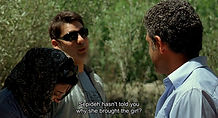
When Peyman enters the frame and reveals that he too knows what's going on: a) the viewer understands that the mystery at hand is known by some and not all in the group, and b) Amir's status as someone who is out of the loop is further emphasized. We also learn here that the "something going on" has to do with why Sepideh brought one of the girls traveling in this group.
3

Next Farhadi cuts to Elly amongst the children. By putting this image directly after Peyman's last line, we can infer that Elly is "the girl" in question. This image also separates Elly from the rest of the adults in the group, which is an important dynamic of her relationship to this group—she is an outsider. Later, she is relegated to watching the kids when she dies/disappears.
4

Farhadi cut to the rest of the group, all joined together now. (In the next cut Amir is in the process of sitting down with the rest of the group which tells us more about how long it's been since image 2). Sepideh's dialogue here further reinforces that there is a deception, albeit a well-intentioned one, at play against Elly, who Sepideh urges the group not to mention "it" to.
7

Peyman's joke here confirms that Elly has been brought along as a potential romantic match for Ahmad. When Peyman is met with a playful slap in response to his joke, he escalates the faux-conflict by saying: "Sepideh, does the girl know Ahmad was married once?". Farhadi reveals that Ahmad has a hidden past which may be in conflict with his eligibility as a good match for Elly.
5

Sepideh's next line furthers our knowledge of the mystery at hand—she wants Ahmad to know that Elly is a nice girl. Another character tells Ahmad that Elly can "sort you out". We can start making inferences about why Elly has been brought along, about what "it" is.
8

Peyman stands up and pretends to call to Elly to reveal Ahmad's divorce, at which point Farhadi frames one of the kids in the background, indicating that Elly is coming back. Farhadi trains the viewer to feel tension at the potential collapse of the web of deceit which Sepideh has begun to spin.
6

Another character, Nazy, is asked what she thinks of Elly. She replies positively to which Ahmad responds, "Already 3 votes". Though this is just an off- handed joke, it also introduces the information that group consensus is an important factor amongst these people, which will become important later as the group struggles to attain consensus during crucial moments.
9

Did you miss this line? Sepideh replies to Peyman that she doesn't know if Elly knows about the divorce. How could Sepideh not know? Sepideh is the one who is setting the two of them up. She must know if she's told Elly this crucial information. If you're paying careful attention, you'll see that Elly seems to be deceiving both Elly and the group with different pieces of information in this scene.
In this clip, we gather a number of details about the premise of the film and the burgeoning character dynamics through Farhadi's strategic exposition. These points will be expanded upon and complicated throughout the rest of the film, and Farhadi does an excellent job of planting his seeds early.
Premise: We learn that 1) Sepideh has brought Elly on this trip in order to set her up with Ahmad, 2) that Sepideh has constructed an air of secrecy around the true nature of Elly's presence, and that 3) Ahmad is divorced and Elly may or may not know.
Character Dynamics: We learn that 1) Sepideh has kept information from Amir about the meaning of Elly's presence, 2) that Sepideh has requested the group keep information from Elly, 3) that Sepideh's plan has relegated Elly to the status of outsider amongst the group, 4) that the group uses Elly's outsider status in order to talk about her behind her back, and even that 5) Sepideh seems to be keeping information from the group as well. We also know that this all stems from what seems like the best of intentions on Sepideh's part. Her comment to Ahmad that Elly is a great girl and that "to know her is to love her" overrides any major sense of dishonesty or deception at hand. For now, the intentions are more significant than the lies.
So What: In this scene, Farhadi uses dialogue, blocking/mise-en-scene (Peyman entering the frame in image 2, the child in the background in image 8) and cross-cutting (cutting to and from Elly in image 3) in order to begin strategically revealing information about the premise of the film while planting the seeds for the web of deception which will ensnare the characters later in the film before collapsing around them entirely.
Farhadi trains his viewer to accept that information will be received in doses by leaving the audience in the dark for the first 3 minutes of the film as far as who the characters are, what they are doing, and how it relates to the premise of the film, and he also begins to shape an experience of distrust and anxiety around information—who has it, who doesn't, and who might be lying. Farhadi also lulls his viewer into a false sense of ease after revealing all this information. We think we know everything. A couple of innocent lies, sure, but otherwise everyone is on the same page. Right? Wrong. Let's look ahead...
2. Building Conflict
When Elly is caught in her lie, she says, "I thought once here, we'd manage". Amir, clearly upset, asks why he wasn't told. "We wouldn't have come at all," Elly replies. Elly's belief that she can control outcomes by selectively delegating information is on full display in this scene. Her lie to the hotel manager shows us that she is willing to stretch the truth in order to get her way. Elly's intentions are pure, but her methods are not.
Next, at 7 minutes into the film, it is revealed that Sepideh has lied to everyone about the conditions of their stay. She was told over the phone that the inn only had capacity to let the group stay for one day, but Sepideh let the group believe they would be staying for three days. Later in the scene, Sepideh lies again, this time to the inn manager, telling her that there is a newlywed couple in the group and that this is something like their honeymoon. We know she is talking about Ahmad and Elly because she mentions "the groom is here from Germany" which aligns with what we know about Ahmad at this point. Farhadi allows us to learn all this information in real time, beginning to shape an experience based on deception.
Now that the premise is firmly established, Farhadi continues to introduce information which shapes our understanding of character dynamics (once again Amir's status as someone who is being kept out of the loop by Sepideh is emphasized, and this time he expresses frustration and pushes back on Sepideh, once again Elly is relegated to outsider status as she remains in the car, and once again Sepideh manipulates information against multiple parties to get her way), and also builds a general atmosphere of distrust regarding information, especially as it pertains to Sepideh. However, once again, intentions outweigh actions and all is good. So much so in fact, that it may escape the viewer upon first watch that the premise of the film is built on a foundation of deceit.
Let's look at a few more examples.
3. Group Dynamics
Why did Asghar Farhadi include this scene at 11:30 in the film, and how does it help set up what is to come? The context of the scene is that the characters are deciding whether to clean up and stay in this broken down abode or to try somewhere else. A vote is proposed. Once again, the importance of group consensus is emphasized. While the stakes are low in this scene and consensus is relatively easy to achieve, this will not be the case later in the film when the group tries to achieve consensus regarding who is at fault and how to proceed with the situation.
Notice that once again, Amir's status as an overlooked voice in the group is reinforced. He is assumed to be in agreement with his wife, Sepideh, and he voices dissatisfaction with this, though it is easily resolved. This tension will eventually boil over as the stakes intensify and the chasm between Amir's opinions and Sepideh's decisions grow wider. Notice once again that Elly is isolated from the group, a dynamic which will also intensify as the film continues. When heating water in a kettle, the temperature slowly rises until a boiling point is achieved. The same is true in film. Farhadi is carefully planning the groundwork of an unstable foundation which will collapse later in the film. In doing this, Farhadi is able to maximize the intensity of the drama to follow. Let's view a few more examples of the lead up to the major incident of the film.
4. Foreshadowing Tragedy
4. The Parallel Case
As Farhadi builds up to the tragedy, he also creates a parallel case for Elly's desertion of the group as a result of her status as an outsider, which keeps the aftermath of the tragedy more dimensional and suspenseful—by building this parallel case, Elly's death is never a certainty until the very end and thus the viewer is kept guessing and reassessing where blame and responsibility truly lie.
5. Finally, Burgeoning Love
One thing we can't forget is in the foreground of this entire introduction is the false premise—the love story. While Farhadi lays the groundwork for deception, mistrust, miscommunication, and ultimately tragedy in the first thirty minutes of the film, he hides it all by diverting the viewer's attention towards the supposed premise of the film, the burgeoning romance between Elly and Ahmad, which of course immediately reaches a dead end after Elly's disappearance around 35 minutes in. Not only is Farhadi able to misdirect the viewer with this false, premise, the tragedy and later chaos becomes that much more dramatic given the audience's dashed hopes.
Farhadi's About Elly is a masterclass in dramatic structure. Each moment in the first third of the film is a building block in the film's foundation. As a result of Farhadi's strong foundation, when the tragedy occurs, the dramatic impact of the fallout is maximized. You can look at any moment in the first 35 minutes of the film and connect it to something that happens either during the tragedy or in the aftermath. This is airtight filmmaking, in which every moment happens for a reason.


This seemingly innocuous moment at 9 minutes into the film when the group arrives to the oceanside inn actually reveals exactly how the tragedy will happen later. Arash escapes adult supervision and makes his way somewhere undetected. In this case, it is harmless, but when he repeats this behavior in the ocean, it will lead to Elly's death.
Immediately following the moment at the gate, the children are seen running down to the shore without their parents, once again foreshadowing the tragedy to follow.
During the scene mentioned earlier in this post around 11 minutes into the film in which the group votes on whether to stay or leave, Farhadi cuts to this ominous wide shot of the children playing by themselves by the shore.

At 13 minutes into the film, Shohreh calls Arash away from the water and states "she'll be worrying all weekend" to which her husband Peyman replies with the line pictured above. Later in the film, Peyman lashes out at Shohreh and states that Elly has died because of their son—perhaps a reflection of his own guilt.

Later around 17 minutes into the film, Peyman is heard yelling at Arash to get out of the water. This is presented somewhat chaotically; Peyman's voice is heard while we see the innkeeper's son running in a handheld panning shot, which we cut to from an unrelated shot. This is an early version of the chaos that will follow.

At 31 minutes into the film, only a few minutes before the tragedy will occur in the film, Shohreh is seen in the background of another scene calling out for Arash. Farhadi continues to set up the premise that Arash is likely to wander off without adult supervision. About 30 seconds later Farhadi cuts back to Shohreh who has located Arash. She tells him "don't go in the water".

Around 16 minutes into the film, Elly exits the group and goes outside by herself. Farhadi continues to build the case that Elly is separate from the group, and the premise that she would leave the group while they're not looking is established here. This premise becomes an option that is considered as an explanation for her disappearance later in the film.

At 18 minutes into the film, Elly makes this phone call to her mom. She establishes an intention to leave the group before the trip is over. She also mentions on this call that she is with her work colleagues, which we know is not true, and asks her mom not to tell anyone she's away—which means she must be hiding this from someone. Elly's desire to leave, willingness to lie, and the mystery of who she is hiding from will later give legs to the theory that perhaps she has left, not drowned.

Later, in the car with Ahmad, Elly receives a phone call which she does not answer. Again, this adds to the air of mystery and intrigue around Elly. We can understand that there is something going on which we will continue to learn about. With the caller still not identified after Elly's disappearance, we understand that her story is not over with yet.


When Ahmad and Elly arrive back at the inn, Sepideh must continue her lie about the newlyweds to the innkeeper, identifying Elly as the bride. The innkeeper's congratulations on her marriage confuses and embarrasses Elly. This moment, among many others early on, adds fuel to the theory that Elly decided to leave the trip.

Later, when Elly goes to get salt in the kitchen, the group builds on the bride and groom bit and jokes about it, which Elly hears and is troubled by. We can understand that she is embarrassed, but the moment seems to take on extra weight due to Farhadi's careful composition and the duration of the shot.
At 30 minutes into the film, just 5 minutes before the tragedy will occur, Elly expresses to the women in the group that she would like to leave. Sepideh insists that she must stay. This scene strengthens the theory that she did leave, while Sepideh's strong desire to make her stay adds weight to the blame that lands on Sepideh if it is true that Elly drowned.


In the first thirty minutes of the film, Farhadi brings Ahmad and Elly closer and closer. In the initial scene we looked at in this post, which occurs around 3.5 minutes into the film, Ahmad and Elly aren't close at all—Ahmad is with the adults, while Elly is with the children, but the topic of Ahmad and Elly has been broached. They next share a brief moment around 7 minutes in when the group arrives at the inn (the first image on the left above). From outside the car, Ahmad looks in through the window at Elly and smiles. The film then cuts to Elly, who bears a contented expression. Next, once at the shorefront abode around 14 minutes into the film, Ahmad and Elly interact across the barrier of a window once more–but this time the window is cracked, and they share words through it. Their next interaction happens around 21 minutes into the film. Now they are both on the same side of the glass, having a full on conversation in a car. Though they are still separated slightly by the physical confines of the car seats, they are much closer than the previous examples and are able to have a conversation in which they share more intimate details about their lives. Farhadi tricks us here again by resolving the tension over the divorce which he plants in that initial scene we looked at. Ahmad tells Elly about his previous wife and she reacts amicably. Any tension you might be subconsciously feeling at this point in the film? Forget about it, Farhadi says with this scene, all is in harmony. The lovers are getting closer. Finally, at 24 minutes into the film, Farhadi brings Ahmad and Elly right next to each other, with nothing physical in between them, and now they are sitting close to each other in the public context of the group. The attachment is burgeoning and being brought out into the light. We think we know where this film is leading us. We don't.